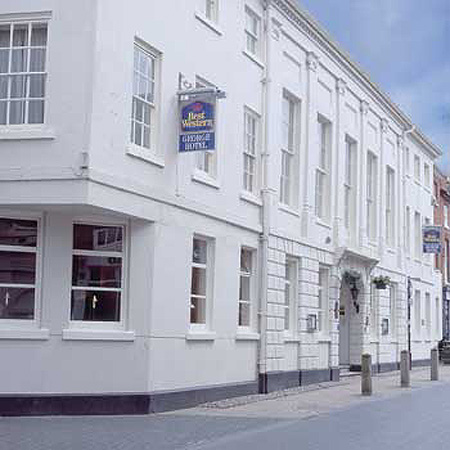
A plaque on the wall of the George Hotel states that playwright George Farquhar stayed here whilst recruiting troops in Lichfield and he wrote some of his play
The Recruiting Officer here around 1705/6. Dublin born Farquhar initially became an actor but gave up the stage after
accidentally wounding a fellow player during a fencing scene. He then took to writing comedies, the last two of which, 'The Recruiting Officer' and 'The Beaux Stratagem' were his best and
are still regularly performed today.
The Beaux Stratagem was actually written about life at The George and certain characters are based on the family who ran the
inn at the time. The play tells the story of two young bucks - Aimwell and Archer, who, having spent all their money by living too well in London, leave the capital and roam from town to town in search of love
and fortune. In order to find a wealthy heiress for at least one of them, they pose as master and servant - exchanging roles from one town to the next.
The play begins in Lichfield, with Boniface, the seemingly honest and hospitable innkeeper welcoming the arrival of the two confidence tricksters. They do meet two lovely, wealthy women but problems
abound. As the story unfolds it is revealed that almost none of the players are quite who they seem. When Archer entrusts a strongbox full of money to the cheery host, Cherry, at first suspects
Archer of being a 'parliament-man', come down to Litchfield to buy votes. But later she decides he and his servant are highwaymen in disguise. Boniface is in fact in league with a gang of thieves led
by the highwayman Gibbet (disguised as a soldier). About the only person who turns out to be what they appear is Cherry.
At the time Farquhar stayed here the George was a galleried inn and Snape's map of 1781 shows it as a compact square of buildings around a courtyard - the entrance being on Bird Street.
When the railway system was established in 1838, travel by stage coach disappeared and the archway in the centre, through which the coaches passed to reach the inn-yard behind, was blocked in. The
George was later redeveloped as an hotel with provisions for persons to stay for more than a day or two. Over the past few years The Victorian George has been restored to its former glory.
Location : Grid Ref : SK115094 - What3Words : tested.coffee.artist - Post Code : WS13 6PR
The Swan on Bird Street, Lichfield, was originally an old Posting Inn. Dr. Samuel Johnson stayed here with his great friends Mrs Hester Thrale and her brewery owning husband. Samuel Johnson was born in Lichfield
and his birthplace museum is situated at the corner of Market Street and Breadmarket Street opposite the market square. James Boswell, Johnson's companion and biographer also stayed here.
The earliest mention of The Swan is in the Estates of the Cathedral Clergy. The 'vicars choral' received grants of houses, land, and rent charges from the early 13th century and became the largest clerical
landowners in the town. A rental of 1497–8 shows the extent of their property, which included the Swan in Bird Street acquired in 1362.
In 1535 the inn was known as the 'Lily White Swan'. In 1572, The international Guild of Town Pipers known as 'The Waits' played at The Swan and were praised by visitors who heard them. The Waits were here again
in 1634, when they travelled to Wollaton Hall, Nottinghamshire to play for the Willoughby family.
Like all public houses still standing, it has constantly been remoulded. The 17th and 18th century saw the most improvements to the three storey building. It grew to be one of Lichfield's two principal Coaching
Inns, serving the London to Holyhead and Carlisle road. In the later 1740s a cockfighting tournament was held at The Swan and a cock pit was mentioned here in 1800 but in 1828, the Lichfield City bailiffs closed
The Swan pit. By 1876 gentlemen were still able to enjoy hare-coursing and a club was established by the landlord of The Swan, with meetings held on estates around Lichfield. The club still existed in 1891.
In 1881, the Hotel Keeper at The Swan was Sarah Marie Owen, a fifty year old widow from Stourbridge in Worcestershire, who had three daughters and two sons. Her staff included a kitchen maid, cook, washer,
chambermaids, parlour maid, billiard marker, barmaids and servants. In 1901, a bowls club was established at The Swan, using a green on the north side of the building. In 1922 the club was named The Swan Bowling
Club.
On the 5th of February 1952, The Swan building was listed Grade II by English Heritage. In the late 1980s, it was in use both as a bar and college. In early 2000, due to dwindling use and rising costs, The Swan
Inn closed. On the 10th August 2005 the building reopened as an accommodation development by Oakmoor Estates comprising of nine suites and part is now an Italian restaurant.
Location : Grid Ref : SK115095 - What3Words : drive.dish.harsh - Post Code : WS13 6PW

Copyright T.W. Townsend - the opinions expressed herein are those of the author and any observations were correct at the time of the review.