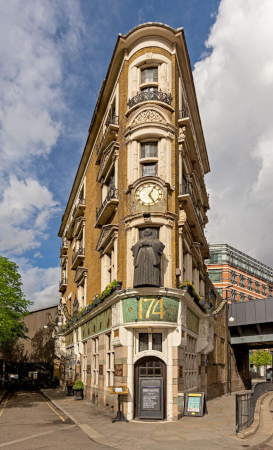
This striking Grade II Art Nouveau masterpiece has stood proudly in the heart of Blackfriars since 1875 on a narrow triangular site almost underneath the railway to Holborn
Viaduct.
The Black Friar is featured in Lesley Grant-Adamson's novel 'Wild Justice' as a place where the author and her writing partner met for a writer's meeting. The setting of Fleet
Street in the 1980s during a heatwave positively thrives on intrigue and where the phrase 'stab in the back' is synonymous with a journalist being summarily sacked, often
whilst in the pub.
The exterior of The Black Friar is intriguing enough with its famous guardian black friar above the front door plus intricate mosaic work, wrought iron hanging signs and copper
panels of monks pointing to the saloon bar. But much more is to come; this wonderful pub is best known for its religious-themed opulent interior with polished marble,
ornamental balconies, mirrors, mosaics, bronze gargoyles, stained glass window panes plus a massive open fireplace with two cosy little inglenooks. The snack bar, added in
1917-21, sits under the neighbouring railway line and provides a stunning attraction with its barrel-vaulted ceiling.
Built on the site of a Dominican friary, this curious building was redesigned by architect Herbert Fuller-Clark in around 1905, with most of the internal decoration provided
by artist Henry Poole and sculptor Frederick Callcott. Their commitment to the freethinking arts and crafts movement can be seen and enjoyed throughout.
This wonderful building was saved from demolition and redevelopment in the 1960s by a campaign led by poet, writer and architectural champion Sir John Betjeman.
Location : Grid Ref : TQ316809 - What3Words : major.hits.digs - Post Code : EC4V 4EG
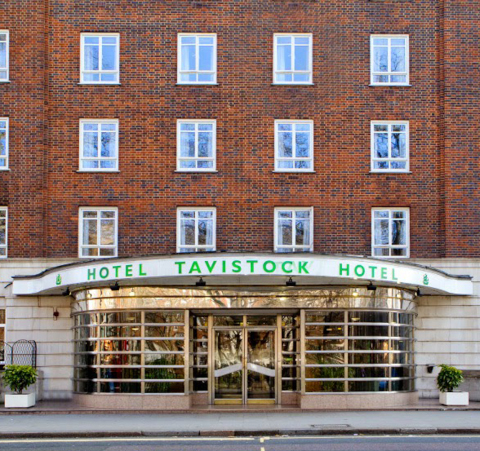
The Tavistock Hotel, completed in 1951 on the south side of the square, is a mecca for Virginia Woolf fans. Part of it stands on the site of Virginia and Leonard Woolf's property
at 52 Tavistock Square, three houses from Southampton Row.
A blue plaque to the left of the front entrance honours Virginia and Leonard Woolf. It was from this location the couple ran the Hogarth Press, which became a prominent and
influential publisher at the forefront of modernist fiction and poetry (publishing T.S. Eliot, E.M. Forster and Katherine Mansfield among others) plus translating the works
of Sigmund Freud into English.
Number 52 was the Bloomsbury house where Virginia lived for the longest period - 1924 to 1939. It is also where she wrote most of her novels plus the extended essay A Room
of One's Own, first published in 1929. Divided into six chapters, the work is based on two lectures Virginia delivered in October 1928 at two women's colleges in Cambridge -
Newnham and Girton.
In the essay Virginia declares: 'One cannot think well, love well, sleep well if one has not dined well.' This is surely a perfect invitation today to sample the fare on offer
at the Woolf & Whistle Bar. The relaxed bar/restaurant with its comfortable seating, is nestled in the Art Deco ground floor of the Tavistock Hotel. The menu includes a
selection of nibbles, light bites, British dishes, desserts and drinks. A bust of Virginia, cast from a 1931 sculpture by Stephen Tomlin (1901-1937), was unveiled in 2004
at the southwest corner of the square.
Location : Grid Ref : TQ299822 - What3Words : spike.driven.drum - Post Code : WC1H 9EU
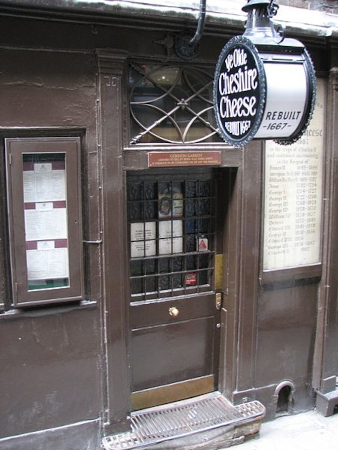
Approached through a narrow alleyway off Fleet Street, this splendid old tavern beckons you into a bygone world whose best introduction is a rhyme by John Davidson:
"I know a house of antique ease / Within the smoky city's pale, / A spot wherein the spirit sees / Old London through a thinner veil. / The modern world so stiff and stale,
/ You leave behind you when you please, / For long clay pipes and great old ale / And beefsteaks in 'The Cheshire Cheese'".
Dr. Johnson's house in Gough Square is just round the corner. When he got fed up with compiling his dictionary and
acted on his famous suggestion "let us take a walk down Fleet Street", the Cheshire Cheese would have been a port of call. Inside there is a portrait of the great man and his
chair is displayed upon a shelf. Other famous writers drawn here to drink in the beer, the wine and the atmosphere have included Oliver Goldsmith, Voltaire, Thackeray, Mark Twain,
Conan Doyle and G.K.Chesterton who used to dress up as Johnson for costume dinners held here.
In the 1890s the famous Rhymers Club used to meet here. W. B.Yeats recalled the experience in his poem 'The Grey Rock':
" Poets with whom I learned my trade / Companions of the Cheshire Cheese" and asks the question: "When cups went round at close of day / Is not that how good stories run?"
There is a chapter devoted to Yeats's poem; the pub and the 'Companions' in 'That Irishman', a book about John O'Connor by Jane Stanford.
Dickens features the pub in 'A Tale of Two Cities'. Following Charles Darnay's acquittal on charges of high treason, Sydney Carton invites him to dine: "Drawing his arm through his own,
he took him down Ludgate Hill to Fleet Street, an so, up a covered way into a tavern. Here, they were shown into a little room, where Charles Darnay was soon recruiting his strength with
a good plain dinner and good wine; while Carlton sat opposite to him at the same table, with his separate bottle of port before him".
The dark wooden interior is an enchanting warren of narrow corridors and staircases, leading to numerous bars and dining rooms. The board, to the right of the entrance (seen in the photograph)
lists the reigns of the 15 monarchs through which the pub has survived. The vaulted cellars date to a 13th century Carmelite Monastery guest house which originally occupied the site. A later
hostelry, the Horn Tavern, recorded in 1538, was destroyed in the Great Fire of 1666. The building you see today was built in the following year.
Location : Grid Ref : TQ314811 - What3Words : stays.chimp.punchy - Post Code : EC4A 2BP
The Flying Horse is the only pub on London's famous Oxford Street. For over a hundred years it was known as the Tottenham but was changed back in 2015 to its even older name. The tall narrow Flemish style
exterior is echoed inside by a striking long narrow bar with tiling, oak panelling and sumptuous painted mirrors by Victorian decorative artist Felix de Jong. It's on the Campaign for Real Ale's National
Inventory of Historic Pub Interiors.
The pub is a favourite hangout of TV detective Cormoran Strike from the TV series 'Strike' based on the novels of Robert Galbraith (aka J.K. Rowling) and it appears in every one of the stories. It is the place
Strike associates with escape and refuge. We first encounter the pub in The Cuckoo's Calling when Strike goes here to escape Robin on her first day as a temp. In Chapter 5 JKR provides us with this description:
"The ornate Victorian face of the Tottenham pub rose up behind the rubble and roadworks, and Strike, pleasurably aware of the large amount of cash in his pocket, pushed his way through its doors, into a serene
Victorian atmosphere of gleaming scrolled dark wood and brass fittings. Its frosted glass half-partitions, its aged leather banquettes, its bar mirrors covered in gilt, cherubs and horns of plenty spoke of a
confident and ordered world that was in satisfying contrast to the ruined street. Strike ordered a pint of Doom Bar and took it to the back of the almost deserted pub, where he placed his glass on a high
circular table, under the garish glass cupola in the ceiling."
Seven changing real ales are sold here and there's a good selection of craft beers as well. Lunchtime food is served and the pub shows sport on TV. The downstairs of the pub includes extra seating and a second
bar. The room is also available for private hire.
Location : Grid Ref : TQ298813 - What3Words : cargo.trunk.wounds - Post Code : W1D 1AN

Sir Alan Herbert, known as A.P.H., was a humorist, novelist, and playwright. He was also a member of the Thames Conservancy Board and a Freeman of the Company of Watermen and Lightermen. He loved
London's river and five years before he died he wrote a book simply titled 'The Thames' in which he explored the 'machinery' of the river in all its aspects. But the book he is best remembered for
is his delightful novel 'The Water Gipsies' published in 1930, in which the Black Lion appears as The Black Swan.
The story concerns the daughters of Albert Bell, an out-of-work Music Hall pit orchestra trumpeter who is in love with Mrs Higgins, licensee of the Black Swan. Bell's daughter, Lily, is a good-natured
good-time girl but his other hard-working daughter Jane is the main interest. She is essentially an unsophisticated dreamer with three suitors; Mrs Higgins son Ernest, a priggish radical, George Bryan,
a posh artist and a young illiterate bargee called Fred, who has the soul of a poet.
The Bells live together "in splendid squalor" on a house-boat called 'The Blackbird', for which Albert pays six shillings a week mooring charge to Mrs Higgins who also owns the wharf. "The Blackbird
was an old London River sailing-barge, though now she had neither mast nor rigging, but lay, a sheer hulk, against Valentine Warf, a little below the Black Swan inn. Mr. Bell had chosen this place for
the Blackbird because of the Black Swan, which seemed to him an omen, for he was that kind of man.."
A number of scenes are set in the pub which was A.P.H's local. He lived nearby in a cottage set back a little from the river, a few steps from the Black Lion. On the front of the cottage, at number 12
Hammersmith Terrace, a Blue Plaque informs us that Sir Alan Herbert, author,
humorist and reformist MP lived and died here. A.P.H. was a regular skittles player at The Black Lion and there is an action
photograph of him in the pub with the caption:"Sir Alan Herbert MP, President of the club swings into action.".
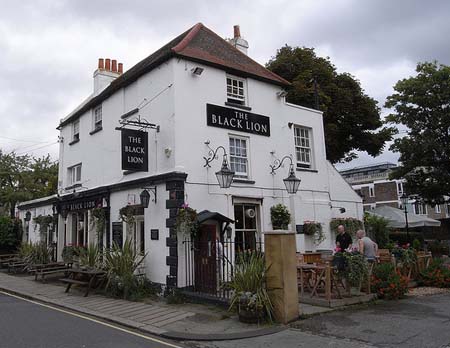
The Black Lion; a popular pub for its location, garden and food was built at least 200 years ago. There is one open bar which divides naturally in to three areas; each has a mix of low ceiling, bare
floorboards and panelling, creating the atmosphere of a cosy country pub. The most distinctive room is the former lengthy skittle alley. Outside there�s a pleasant seating area under an old, gnarled
chestnut tree, thought to be older than the pub itself.
Location : Grid Ref : TQ221782 - What3Words : tall.films.feast - Post Code : W6 9TJ
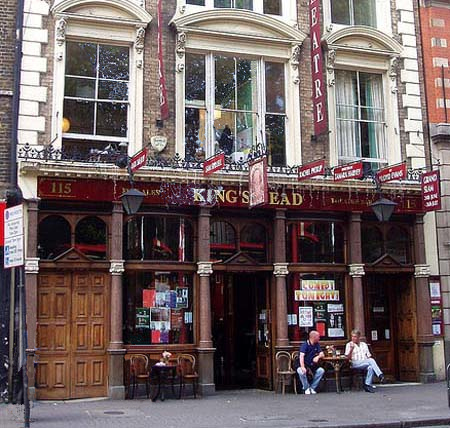
Hard to think how you could possibly find a more literary pub than one that is home to a theatre looking for new playwrighting talent. But that is just what we have now in a
number of London's larger Victorian boozers. Islington is leading the way and has become the capital's third theatreland, after the West End and the South Bank.
The King's Head, a grand old alehouse, gave birth to this modern pub-theatre movement in 1970, when it was taken over by American impresario Dan Crawford. The theatre in the back
of this now world renowned pub has enjoyed over 40 transfers to the West End and Broadway. Some of the many stars who have appeared here, beneath the leaky roof, include Joanna Lumley,
Alan Rickman, Steven Berkoff, Victoria Wood, Maureen Lipman, Sir Tom Stoppard, Sir Antony Sher, Richard E Grant & Rupert Graves. The authentic Victorian pub has roaring fires in
winter and is decorated with photos of familiar faces who have graced the stage over its 40 year history.
Marian Babson is the pseudonym of Ruth Stenstreem, the American mystery writer who was, for a while, secretary to the Crime Writers' Association. Babson was born in Salem, Massachusetts
but has lived the majority of her life in London. Her books are generally more in the line of gentle thrillers than actual mysteries. Allowing for the fact that she is from the US, the
publisher's tagline for her is "Murder Most British," and the style of her books reflects that. The violence is not graphically described and the sleuths are usually bumbling amateurs.
In her quirky novel 'Break a leg Darlings', we are introduced to former movie stars Trixie Dolan and Evangeline Sinclair.
The ageing actresses are looking for a play in which to star and, pursuing this ambition, the thespian duo attends a series of 'pub theatre' productions which brings them to here to the
King's Head.
The current building dates from 1860 but the pub's website claims that there has been a King's Head Pub on this site in Upper Street since the 1500's and that it is mentioned in Samuel
Pepys's diaries. I have, as yet, been unable to verify this but Pepys authority Claire Tomalin, records, in her biography of the great man, that the diarist and his wife: "Both enjoyed
expeditions to theatres and shops together, as well as summer outings � on the river to Vauxhall or Barn Elms, or by coach to the country inns of Islington and Hackney".
Location : Grid Ref : TQ316838 - What3Words : matter.pizza.period - Post Code : N1 1QN
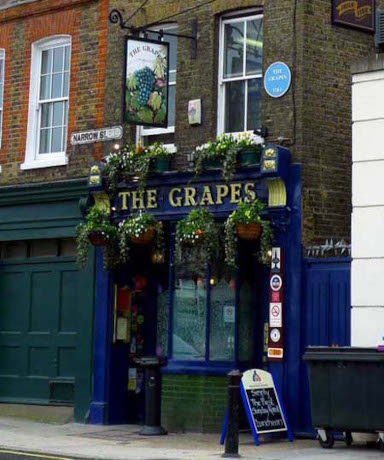
Charles Dickens knew this pub and the area well from visits to his godfather, Christopher Huffan: "a rigger, and mast, oar and block maker" who "lived at Limehouse in a substantial, handsome
sort of way" - in Church Row (now Nevil Street), which is just around the corner from The Grapes. As an adult, Dickens immortalised the pub in
'Our Mutual Friend' as the 'Six Jolly Fellowship Porters'; taking the name from one of the old City Guilds.
"The Six Jolly Fellowship Porters, already mentioned as a tavern of a dropsical appearance, had long settled down into a state of hale infirmity. In its whole constitution it had not a straight floor,
and hardly a straight line; but it had outlasted, and clearly would yet outlast, many a better-trimmed building, many a sprucer public-house. Externally, it was a narrow lopsided wooden jumble of corpulent
windows heaped one upon another as you might heap as many toppling oranges, with a crazy wooden verandah impending over the water"
The ultra-modern surroundings of this warmly welcoming 16th century tavern make the fact it's survived so unscathed all the more remarkable. It was built in 1720, on the site of a previous pub in what is
now a peaceful spot well off the tourist route, at the end of a row of similar dwellings; some of whose residents are knights and lords. The Grapes is one of London's most engaging riverside taverns and
is now a listed building, The front bar has dark stained timber clad walls; an assortment of odd wooden chairs and tables and bare floorboards. The back bar has an open fire and steps leading to a deck
over the Thames. Up some very narrow stairs is the small restaurant which looks out over the river. Little has changed inside since Dickens's description of 1864, in what was to be his last completed novel:
"The bar of the Six Jolly Fellowship Porters was a bar to soften the human breast. The available space in it was not much larger than a hackney-coach; but no one could have wished the bar bigger,
that space was so girt in by corpulent little casks, and by cordial-bottles radiant with fictitious grapes in bunches, and by lemons in nets, and by biscuits in baskets, and by the polite beer-pulls
that made low bows when customers were served with beer, and by the cheese in a snug corner, and by the landlady's own small table in a snugger corner near the fire, with the cloth everlastingly laid."
Location : Grid Ref : TQ365807 - What3Words : error.glory.boot - Post Code : E14 8BP
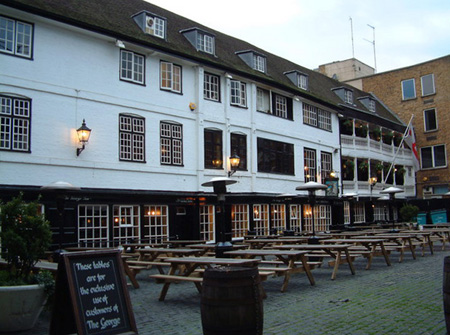
Charles Dickens has a long and deep association with Southwark, both personal and literary. In Pickwick Papers he wrote: "In the Borough there still remain some
half dozen old inns Great rambling, queer old places with galleries, and passages, and staircases, wide enough and antiquated enough, to furnish materials for a hundred ghost stories"
These rambling old inns included the White Hart mentioned by Shakespeare in Henry VI - and where Mr. Pickwick first met Sam Weller. And The Tabard where English literature began in 1388 when
Chaucer's Pilgrims assembled here before setting off for Canterbury. These famous establishments are remembered now only in local street names. Indeed, all of London's old galleried coaching inns are
gone, except for this southern wing of the George now under the secure protection of the National Trust.
Dickens first came to Southwark aged 12, when his parents and siblings, were imprisoned in the Marshalsea Debtors Prison.
The high prison wall remains a few hundred yards south of the George. Many scenes in his novel Little Dorritt, are set in the
Marshalsea where Little (Amy) Dorritt was born and in the nearby church of St George the Martyr where she was christened and eventually married.
In chapter 22 of the novel Amy's brother Tip intercepts Maggy (Amy's friend) as she is leaving the Marshalsea. Maggy is delivering a begging letter from the imprisoned Mr. Dorritt to Arthur Clennman.
Tip makes Maggy wait while he goes in to the George to write a plea on his own behalf to add to her errand. Tip would have used the Middle Bar Coffee Room for this purpose which was a haunt of
Charles Dickens and where his life insurance policy is now displayed.
The George stands on the south bank of the Thames near London Bridge - for centuries the only bridge across the river. It was rebuilt in 1676, after a devastating fire swept Southwark. Turning into
the yard today from the busy high street is to be transported back to a bygone age. The ground floor with its wealth of pretty lattice windows and oak beams is divided into several connecting bars
including the Old Bar which was the waiting room for coachmen and passengers. The restaurant now occupies what were once the galleried bedchambers. Real ale and traditional pub grub is available
lunchtime and evenings.
Location : Grid Ref : TQ326801 - What3Words : petal.mouse.slides - Post Code : SE1 1NH
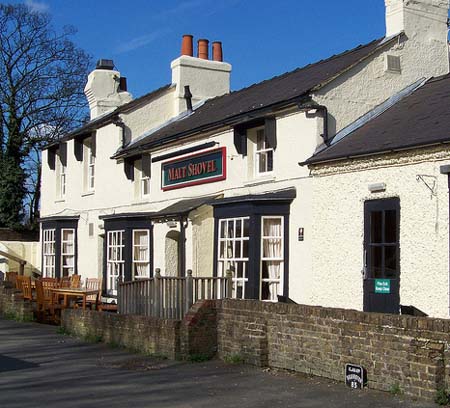
Chapter 11 of A. P. Herbert's exquisite tale 'The Water Gipsies', is titled 'Up the Cut' referring to the first stage of the journey out
of London that working boats made along the Grand Union Canal, when carrying goods from the Capital to Birmingham. Fred Green,
the illiterate, good-hearted bargee, works the narrow-boat Prudence with his parents. He has managed to persuade them to allow his sweetheart Jane Bell to join them on a trip, but the situation is fraught
with problems.
Jane is a simple servant girl but she has a rival suitor, the priggish radical Ernest Higgins. She is also secretly in love with a posh artist, Mr. Bryan who she waits on and who she has been posing for.
The beginning of the journey is a little edgy for Jane in the strange confined world aboard the Prudence. The boat glides along as Jane begins to share the work and learn the mysteries of locks but the
scenery at first is uninspiring.
"Then came a dull six miles past Southall and West Drayton, tall factories and mean houses and never a lock; but at last the canal crept out into the fields, and a leafy reach up to Cowley lock, where
there was an inn beside the towing-path, and here they lay for the night".
The inn in question is the canal-side Malt Shovel and, after they had moored, and Beauty the horse was fed and stabled for the night, Mr. Green said:"what he wanted was an old and mild, and crouching
carefully, he climbed over Mrs. Green and Fred and departed for the pub". Soon after Fred joined his father and, a little later, in the warm public bar, the women arrived to find:
"Fred and Mr. Green were playing dominoes with a very noisy old boatman from the Severn Sisters, Jane drank lemonade and Mrs. Green stout, and for a long time neither of them said a word. Fred's eye
wandered continually from the dominoes to Jane. Till Mrs. Green told him about it."
Today the 19th century listed Malt Shovel is a friendly country pub and restaurant. The big front bay windows in the whitewashed walls give a light and airy feel to the tastefully decorated interior.
The cosy dining area has a mix of traditional furniture with lots of fairly private areas. And the canal-side location makes it a perfect summer venue.
Location : Grid Ref : TQ051822 - What3Words : woven.froze.myself - Post Code : UB8 2JE
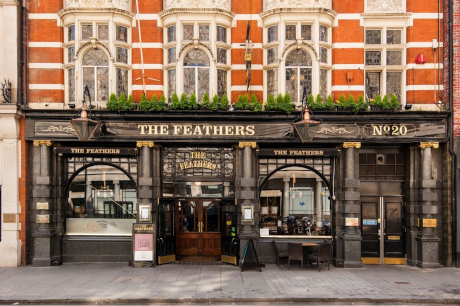
In J.K.Rowing's thriller The Cuckoo's Calling, her hero Cormoran Strike meets Detective Sergeant Eric Wardle in person for the first time at The Feathers. The pub is convenient for Wardle since it's near
Scotland Yard. It's here that Strike passes information to the Detective Sergeant and hopes it will be in exchange for Lula Landry's case file. In Career of Evil, Strike and his sidekick Robin go to the
Feathers after they've been to Scotland Yard to view the photos of the body (from which Robin had received a leg). Later in the book, Strike meets Wardle here to be updated about the Shacklewell Ripper
investigation.
The sign over this pub's fine Victorian façade commemorates the ostrich feathers of the Prince of Wales. When the pub was built, the then Prince was to become the future Edward VII. Opposite is the grand
head office of the London Transport Executive at 55 Broadway. The sculpted figures facing the pub are by Epstein and depict 'Day', with 'Night' being represented on the other side of the building. They
were hugely controversial in their day and their graphic nakedness caused the managing director of the Underground, Frank Pick, to offer his resignation over the affair.
As you walk in through the front door of The Feathers the bar stretches away on the right hand side with seating areas over to the left. The high ceilings and wooden floor give the pub a traditional feel.
Popular with local office workers and tourists, The Feathers offers up to eight cask ales including a house Pale Ale. At times the pub can be extremely busy with people spilling out onto the street but
late in the evenings when it's empty it can seem a little soulless.
There is a restaurant area, an upstairs function room for hire and TV for major sporting events. The food menu includes Sunday roasts, and a specialty pie range. Takeaway and delivery food options are also
available.
Location : Grid Ref : TQ296794 - What3Words : charmingly.timing.plant - Post Code : SW1H 0BH
Copyright T.W. Townsend - the opinions expressed herein are those of the author and any observations were correct at the time of the review.